
What does SMB1001 Gold certification actually mean, and why should it matter to a business choosing an IT provider? SMB1001 is Australia’s tiered cybersecurity standard built specifically for small and medium businesses, and Gold is the third of five tiers, sitting well above the foundational entry point most businesses start at.
This guide explains what SMB1001 Gold certification actually requires, how it compares to the other tiers, and why XCD IT pursued it.
Key Takeaways
- SMB1001 is a five-tier cybersecurity certification standard for Australian SMBs, Bronze, Silver, Gold, Platinum, and Diamond, maintained by Dynamic Standards International and issued through the CyberCert platform.
- Each tier is cumulative. Gold certification means a business has met every Bronze and Silver requirement, plus the additional governance and resilience controls specific to Gold.
- Gold aligns closely with the ACSC Essential Eight and represents comprehensive cyber resilience, not just basic protection, covering the ability to detect, respond to, and recover from a security incident, not only prevent one.
- SMB1001 certification is increasingly recognised by Australian cyber insurers, government bodies, and enterprise procurement teams as evidence of a credible cybersecurity posture, and Gold in particular reflects the level of control most underwriters and larger supply chains are actually looking for.
- XCD IT has achieved SMB1001 Gold certification, meaning the same standard of governance, access control, and resilience we help clients work toward is one we hold ourselves.
Quick Answer
SMB1001 Gold is the third of five certification tiers in Australia’s SMB1001 cybersecurity standard, sitting above Bronze (foundational hygiene) and Silver (access control and incident response basics), and below Platinum and Diamond.
Gold certification demonstrates comprehensive cyber resilience, meeting requirements across technology, access control, backup, governance, and staff training, closely aligned with the ACSC Essential Eight.
It’s increasingly recognised by Australian cyber insurers and enterprise procurement teams as genuine evidence of a mature security posture. XCD IT holds SMB1001 Gold certification.
What Is SMB1001?
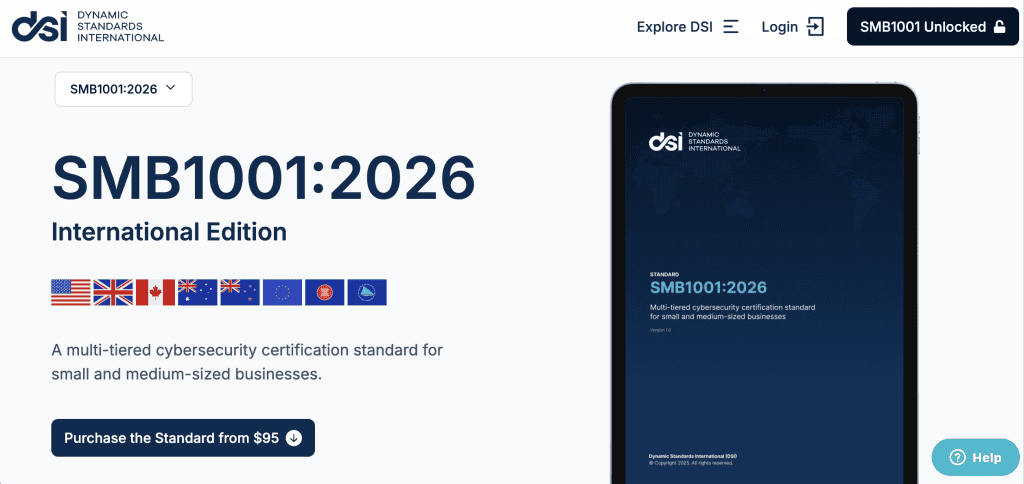
SMB1001 is a cybersecurity standard built specifically for small and medium businesses, developed and maintained by Dynamic Standards International.
Unlike enterprise frameworks such as ISO 27001, which is an information security management system, SMB1001 is a more cost effective alternative to traditional standards and enterprise level standards, with a simpler scope than cybersecurity maturity model certification.
It provides a structured pathway and clear roadmap for small business and medium-sized businesses, allowing businesses to improve their security maturity over time without adopting the full scope of large-organisation requirements. For a broader look at how SMB1001 fits alongside other options, see our guide to cybersecurity certifications for SMBs in Australia.
The standard comprises five progressive tier builds: Bronze, Silver, Gold, Platinum, and Diamond. Businesses can start at any tier based on their needs, then progress over time as each level builds on the previous one rather than facing an all-or-nothing certification.
The current edition is SMB1001:2026, certifiable since January 2026, and it is updated annually to address evolving threats while staying aligned with international standards.
What Each SMB1001 Tier Actually Covers
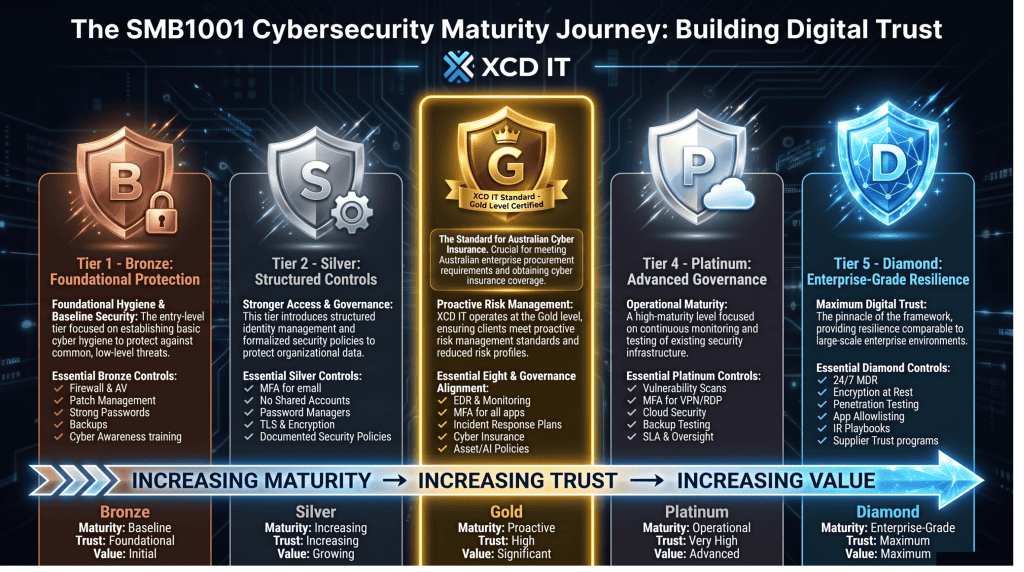
Bronze covers foundational cyber hygiene, the basic controls every business should have in place regardless of size or industry. This typically includes multi-factor authentication, regular patching, antivirus and endpoint protection, basic firewall configuration, and reliable backups.
Silver builds on Bronze by introducing more structured access control, documented incident response procedures, and stronger validation of backup and recovery capability, including recovery planning for a cyber incident. At this level, a business needs to clearly define who has access to what, not just that protections exist.
Gold adds governance and resilience on top of Silver’s controls, and aligns closely with the ACSC Essential Eight. As a mid-tier cyber certification between Silver and Platinum, Gold requires 27 specific gold controls.
These cybersecurity practices include access management, technology management, employee training, and stronger protection of sensitive information to help businesses strengthen their defence against cyber threats. Gold represents comprehensive cyber resilience, the ability to detect, respond to, and recover from a security incident, not just prevent one in the first place.
Certification is valid for twelve months, requires annual renewal, and reflects a certifiable standard that is updated annually to address evolving threats.
This is generally the tier where Australian cyber insurers and enterprise procurement teams start treating certification as genuinely meaningful evidence, rather than a baseline checkbox.
Platinum and Diamond sit above Gold and are generally aimed at businesses handling especially sensitive data or operating in regulated industries, typically involving independent, audit-level verification of controls rather than self-assessment alone; unlike Gold, these higher tiers typically require an external audit.
Why Gold Specifically Matters
Bronze is a meaningful and legitimate starting point for a business beginning its cybersecurity journey, but it’s not designed to demonstrate the kind of mature, resilient posture that larger clients, insurers, or supply chain partners increasingly expect to see.
Gold is where that changes. It is the first tier that includes mandatory cyber insurance, and Gold certification requires mandatory cyber insurance for compliance while its controls align closely with insurer expectations and requirements for cybersecurity controls.
It reflects a business that has moved beyond basic hygiene into genuine governance, structured access control, and demonstrated ability to respond to and recover from an incident in ways that also reduce exposure to cyber attacks, not just prevent one.
For a business evaluating IT providers, or for a provider itself being evaluated by a client, Gold certification is a concrete, third-party-referenced signal that security isn’t being managed informally or reactively.
Insurers often decline coverage without multi-factor authentication controls, so this level supports good cybersecurity and can improve insurability, terms, and coverage for cyber insurance. It can also help meet regulatory compliance requirements more easily, create a competitive advantage, and act as a recognized cybersecurity certification in procurement or supplier reviews.
In some cases, achieving SMB1001 can also lead to significantly stronger outcomes, including substantially higher coverage value.
This is directly relevant to the kind of supplier and franchise compliance expectations covered in our guide to BHP’s minimum requirements for suppliers, where Australian organisations increasingly expect their suppliers and partners to demonstrate exactly this kind of structured, evidenced security posture rather than an informal assurance that “we take security seriously.”
XCD IT Holds SMB1001 Gold Certification
XCD IT has achieved SMB1001 Gold certification. At this level, the certification involves director attestation, with a company director signing off on compliance based on supporting evidence.
That means the standard of access control, governance, and cyber resilience we help clients across Brisbane, Gold Coast, and Sunshine Coast work toward is one we hold ourselves, verified against the same framework, not just recommended from the outside.
For a business choosing an IT and cybersecurity provider, this matters in a practical way. Unlike higher-tier certifications that use independent external verification, this evidence-backed process helps demonstrate robust security and manage cybersecurity risks rather than relying on informal claims.
A provider advising on frameworks, compliance, and security posture should be able to demonstrate the same standard it’s asking clients to meet. SMB1001 Gold gives that a concrete, independently referenced answer, rather than relying on marketing language alone.
Cybersecurity Certification
Cybersecurity certification like SMB1001 Gold provides businesses with a structured approach to implementing essential security controls that reduce risk and enhance cyber resilience.
Achieving such certification demonstrates a company’s commitment to practical steps in cybersecurity, including the use of antivirus software, multi-factor authentication, and employee training. It also ensures that security controls are regularly updated through automatic updates and ongoing monitoring.
For small and medium-sized businesses, SMB1001 Gold certification offers a competitive edge by aligning with industry best practices and insurer requirements, including mandatory cyber insurance.
This practical guide to cybersecurity certification helps businesses simply sign off on their compliance with a recognized standard, giving confidence to clients, partners, and insurers alike.
By following this structured approach and adopting SMB1001 Gold certification, organizations can effectively reduce risk, improve operational continuity during cyber incidents, and position themselves as trustworthy and secure partners in their industry.
Frequently Asked Questions

- 8+ Best Cybersecurity Companies in Brisbane (2026 Guide for SMBs) - November 7, 2026
- 20 Best Managed IT Service Companies in Brisbane (2026 Guide for SMBs) - November 7, 2026
- Co-Managed IT: How It Works With Your In-House IT Team - November 4, 2026


