
What should you actually look for in a secure real estate CRM before signing a contract? Most agencies choose software based on features, price, and how the demo looked, and only think about security and compliance after something goes wrong.
This guide covers what a secure real estate CRM actually needs to include, the state-based trust accounting requirements every platform has to meet, and the questions worth asking a PropTech vendor before you commit.
Key Takeaways of Secure Real Estate CRM
- A secure real estate CRM needs to handle two very different jobs well: day-to-day client and listing management, and legally regulated trust money that belongs to someone else entirely.
- Trust accounting is regulated separately in every Australian state and territory, with requirements like next-business-day banking of rent, regular reconciliation, and annual audits. A platform’s compliance features need to match your specific state, not just Australia generally.
- Since 1 July 2026, real estate agents and buyer’s agents fall under AUSTRAC’s Tranche 2 anti-money laundering obligations, which brings identity verification and reporting requirements that many existing platforms are only now building in.
- Integration matters as much as the platform itself. A CRM that doesn’t talk cleanly to your trust accounting software, or your existing Microsoft 365 environment, creates manual workarounds that are exactly where security gaps tend to appear.
- The market leaders (PropertyMe, Console Cloud, MRI Property Tree, REST Professional, VaultRE) all handle core Australian trust accounting compliance, so the real differentiation for most agencies comes down to integration, audit trail depth, and how well support actually understands your state’s specific requirements.
Quick Answer for Secure Real Estate CRM
A secure real estate CRM needs state-compliant trust accounting (reconciliation, audit trails, correct banking timeframes), strong identity verification given incoming AUSTRAC AML/CTF requirements, granular staff permissions, and clean integration with your existing systems rather than manual data re-entry between platforms.
Established Australian options like PropertyMe, Console Cloud, MRI Property Tree, and REST Professional all cover the compliance basics, so the real decision usually comes down to integration fit, audit trail quality, and vendor support that actually understands your state’s specific trust accounting rules.
Why Security and Compliance Need to Be Part of the Buying Decision
Most agencies evaluate CRM and trust accounting software the same way they’d evaluate any other business tool, on features, ease of use, and price.
That approach misses something important: trust accounting software isn’t managing your agency’s money, it’s managing money that legally belongs to someone else, a landlord, a vendor, a tenant, and Australian regulators treat that distinction seriously.
Platform selection is also just one part of the broader security picture, alongside device management, staff access, and the other requirements covered in our guide to Ray White franchise IT requirements.
Every state and territory regulates trust money through its own legislation. The core principles are broadly consistent, rent needs to be banked promptly (commonly within one business day), trust accounts must be reconciled regularly, and agencies need to produce audit-ready records on request, but the specific mechanics, audit periods, and lodgement deadlines vary by state.
A platform that handles this well in New South Wales won’t automatically be configured correctly for Queensland or Victoria without the right setup.
What a Secure Real Estate CRM Actually Needs

State-compliant trust accounting, not generic accounting
The platform needs to handle trust money as its own distinct category, with the reconciliation, banking timeframes, and audit trail requirements specific to your state, not treat it as a regular accounting ledger with different labels.
A genuine audit trail
Every transaction, adjustment, and disbursement needs to be logged with who did it and when, in a format that satisfies an external auditor, not just an internal report that looks tidy.
Bank feed integration
Automatic reconciliation against live bank feeds significantly reduces the manual entry errors that tend to be where trust account discrepancies actually originate, and most established Australian platforms now support this as standard.
Identity verification capability, especially given AUSTRAC’s Tranche 2 obligations
Since 1 July 2026, real estate agents and buyer’s agents have been brought under AUSTRAC’s Tranche 2 anti-money laundering and counter-terrorism financing regime, which introduces customer due diligence and reporting obligations.
Agencies newly captured by this reform have until 29 July 2026 to complete AUSTRAC enrolment, a deadline that’s now only days away. A platform (or an add-on module) with built-in identity verification, document validation, and sanctions screening is a genuine compliance requirement at this point, not an optional extra.
Granular staff permissions
Not every staff member needs access to every trust transaction or every client record. A platform that only offers all-or-nothing access control makes it much harder to apply the principle of least privilege, giving each person only the access their role actually requires.
Secure owner and tenant portals
Many platforms now offer self-service portals for owners and tenants to view statements and documents. These need their own access controls and shouldn’t expose more data than the specific portal user is entitled to see.
Real Estate CRM and Trust Accounting Platforms Compared
The Australian market for real estate CRM and trust accounting software has a handful of established players, and most agencies shortlist from the same short list.
Rather than rank them on security specifics we can’t independently verify, the table below focuses on positioning and typical fit, use it as a starting point for your shortlist, then confirm the actual security and compliance details directly with each vendor using the questions in the next section.
| Platform | Best Known For | Typical Fit |
|---|---|---|
| PropertyMe | Market leader, largest install base in Australia, reports 6,000+ agencies on the platform | Agencies wanting the most widely adopted, well-supported option |
| Reapit PM (formerly Console Cloud) | Property management and trust accounting specifically (not a sales CRM), rebranded from the legacy Console desktop product | Agencies already on older Console products looking to move to the cloud |
| MRI Property Tree | Backed by MRI Software’s broader property management platform | Larger agencies wanting a bigger connected ecosystem beyond just real estate |
| REST Professional | MRI Software’s established desktop-based property management platform (a sibling product to MRI Property Tree, with an active migration path to the cloud version) | Agencies prioritising property management depth over sales CRM features |
| MRI Vault (formerly VaultRE) | Sales-focused CRM, now part of MRI Software’s portfolio, commonly paired with a separate trust accounting product | Agencies wanting a dedicated sales CRM rather than an all-in-one platform |
It’s also worth knowing that the real estate PropTech market has consolidated more than it might first appear. MRI Property Tree, REST Professional, and MRI Vault (formerly VaultRE) are all now MRI Software products, positioned differently within MRI’s own portfolio rather than fully independent competitors.
Reapit PM sits within a separate group (Reapit), alongside its own dedicated sales CRM product, Reapit Sales (formerly Agentbox). PropertyMe remains independently owned. This matters less for day-to-day usability, but it’s a useful thing to know when a vendor’s sales pitch implies you’re comparing five unrelated companies rather than three genuinely separate groups.
No platform on this list should be assumed to be more or less secure than another based on name recognition alone. Market position and compliance depth are two different things, which is exactly why the vendor questions covered later in this guide matter more than the shortlist itself.
PropertyMe
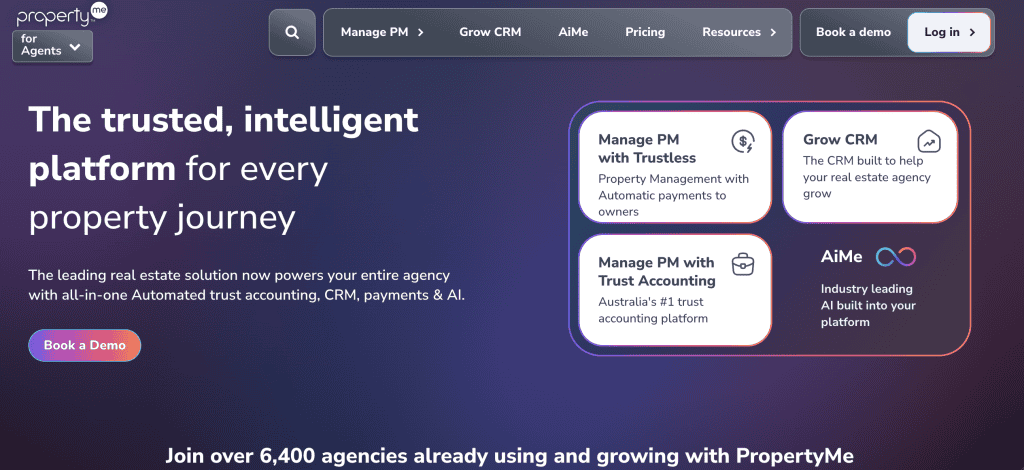
PropertyMe is the most widely used platform in this category, reporting more than 6,000 agencies and over 1.5 million properties managed across Australia and New Zealand.
It combines property management, sales, trust accounting, and CRM functions in one connected platform, and includes an AI assistant (AiMe) for drafting communications and surfacing state-based tenancy guidance, according to PropertyMe’s own product information.
Pros:
- Largest install base means more established integrations, more staff familiar with it if you’re hiring, and a mature support ecosystem
- All-in-one platform reduces the integration risk that comes with stitching together separate CRM and trust accounting products
- Transparent, published pricing rather than custom quotes
Cons:
- Being the market leader doesn’t automatically mean it’s the best fit for every agency size or workflow, it’s worth demoing against your specific processes, not just assuming popularity equals fit
- Per-property pricing can become less cost-effective at very large portfolio sizes, according to third-party PropTech comparisons
Reapit PM (formerly Console Cloud)
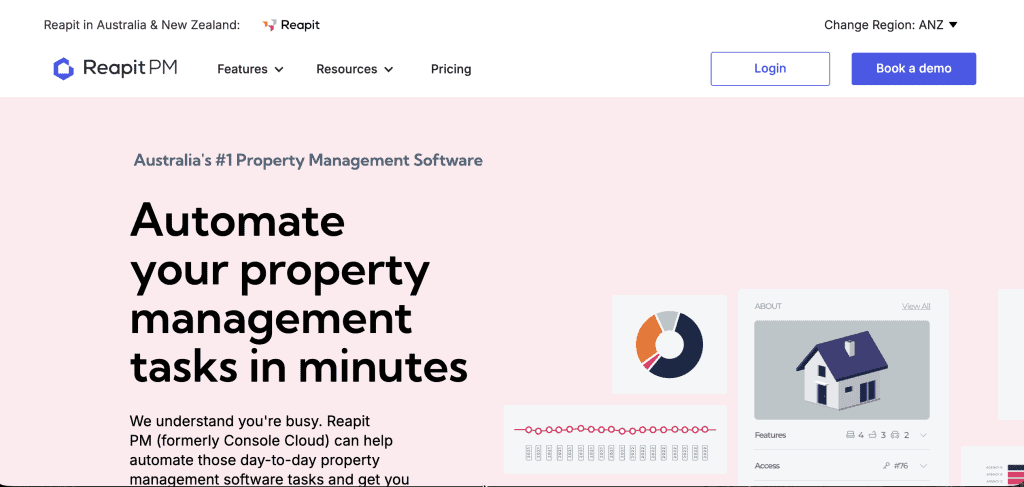
Reapit PM is the current name for the product long known as Console Cloud, following Reapit’s rebrand of its Australia and New Zealand product suite. It is Reapit’s property management and trust accounting product specifically, giving agencies already familiar with Console a migration path rather than starting from scratch on unfamiliar software.
It’s worth knowing that Reapit’s actual sales CRM is a separately branded product, Reapit Sales (formerly Agentbox), so an agency wanting both property management and a dedicated sales CRM from the Reapit family would typically run both products together rather than expecting Reapit PM alone to cover sales as well.
Pros:
- Familiar for agencies with existing Console experience or historical data in the legacy desktop product
- Backed by a large, established property software group (Reapit) with a broader connected product suite available if an agency wants to expand beyond property management alone
Cons:
- The recent rebrand means older references (including in vendor comparisons, staff training material, or search results) may still use the “Console Cloud” name, worth confirming you’re looking at current product documentation, not outdated material
- Agencies not already on Console or the Reapit Suite gain less from the migration-path advantage compared to starting fresh on a different platform
MRI Property Tree
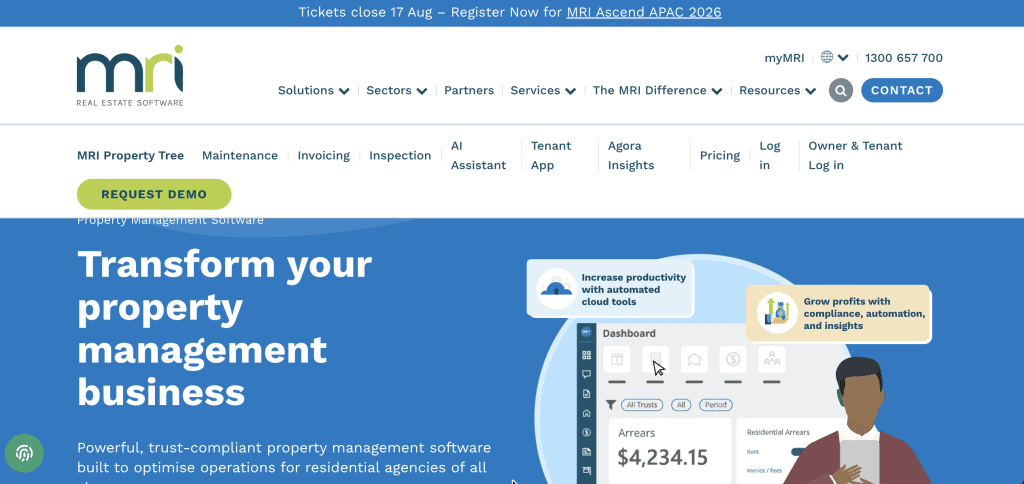
MRI Property Tree sits within MRI Software’s broader property technology ecosystem, which spans well beyond real estate agency management into wider property and real asset software.
Pros:
- Backed by a large, established software company with a broad product ecosystem, which can appeal to agencies wanting a bigger connected platform over time
- Synchronisation capabilities with accounting tools like Xero, useful for agencies with existing accounting workflows outside the CRM itself
Cons:
- Being part of a larger ecosystem can mean more complexity than a smaller agency actually needs
- Worth confirming implementation and support responsiveness directly, since larger vendors don’t always match the hands-on support smaller, real-estate-specific vendors provide
REST Professional
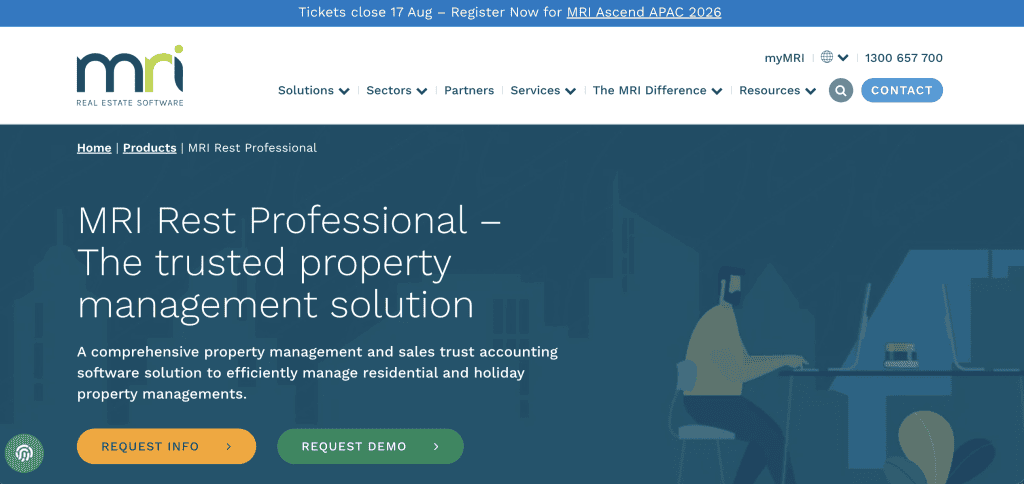
REST Professional is a long-standing, established name specifically in property management software, now owned by MRI Software, the same company behind MRI Property Tree. MRI actively promotes REST Professional as the desktop-based predecessor to Property Tree, with an established migration path for agencies moving to the cloud.
Pros:
- Deep, long-term focus specifically on property management rather than being a generalist business platform with real estate features bolted on
- Well understood by property management-trained bookkeepers and virtual assistants, which can simplify outsourcing trust accounting tasks if your agency uses external support
Cons:
- Sales CRM capability is generally less of a focus than dedicated sales-first platforms, worth checking if your agency needs strong sales pipeline features alongside property management
- As with any established platform, confirm current cloud capability and mobile access specifically, rather than assuming it matches newer cloud-native competitors feature for feature
MRI Vault (formerly VaultRE)
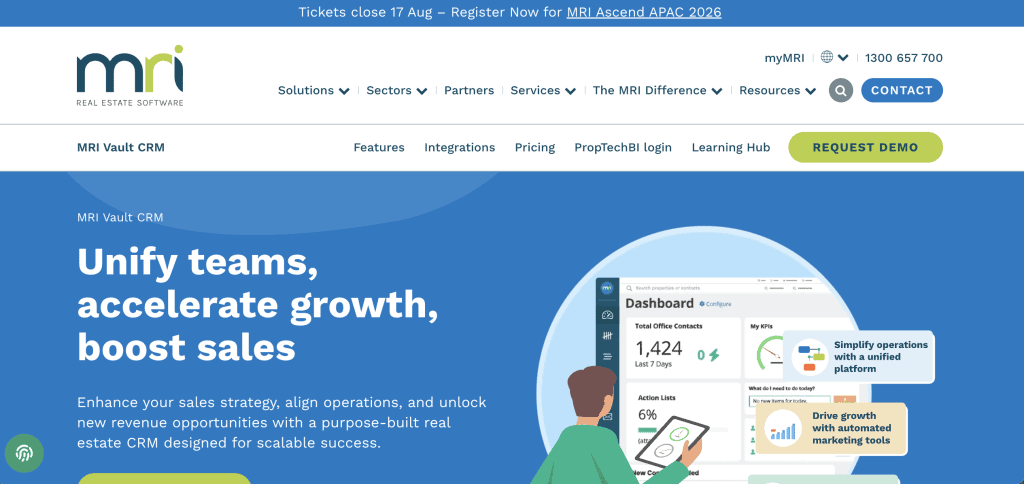
MRI Vault is the current name for the platform long known as VaultRE, following its acquisition and rebrand under MRI Software. It’s positioned primarily as a sales-focused CRM, commonly used by agencies that pair it with a separate, dedicated trust accounting product rather than expecting one platform to do both jobs equally well.
Being part of the MRI Software family means it now sits alongside MRI Property Tree and REST Professional in the same portfolio, worth knowing if you’re also considering either of those for trust accounting specifically.
Pros:
- Strong dedicated focus on sales workflow and agent productivity, which can outperform all-in-one platforms for agencies whose primary need is sales CRM strength
- Flexibility to pair with the trust accounting product of your choice, rather than being locked into one vendor’s approach to both functions
- Backing from MRI Software’s broader resources, following the acquisition, which can mean more stability and ongoing investment than a smaller independent vendor
Cons:
- Requires managing and integrating two separate systems (CRM and trust accounting) rather than one, which brings back the integration risk discussed earlier in this guide
- Less suited to agencies wanting a single, all-in-one platform with minimal vendor coordination
- The recent rebrand means older references (including staff familiarity, training material, or search results) may still use the “VaultRE” name, worth confirming you’re looking at current product documentation
Integration Considerations Most Agencies Underestimate
A platform can be secure in isolation and still create real risk if it doesn’t integrate cleanly with the rest of an agency’s systems. This is one of the most common gaps we see when reviewing an agency’s actual setup.

CRM to trust accounting
If your CRM and trust accounting software are different products, check exactly how data flows between them. Manual re-entry between systems is slow, but it’s also a common source of errors and a place where sensitive data can end up copied into spreadsheets or emails that were never meant to hold it.
Microsoft 365 and email
Most agencies run email and document storage through Microsoft 365. A CRM or trust accounting platform that integrates cleanly with that environment, rather than requiring a completely separate login and workflow, reduces the number of places sensitive data can end up scattered across.
Mobile access
Given how much real estate work happens outside the office, confirm how the platform handles mobile access specifically, and whether that access can be centrally managed the same way a desktop login can, a consideration covered in more depth in our guide to mobile device security for real estate agents.
Reporting and export
Understand exactly what data can be exported, by whom, and in what format. A platform with strong internal controls but unrestricted, unlogged export capability has a real gap sitting in an obvious place.
Questions to Ask a PropTech Vendor Before You Commit
- Which specific state and territory trust accounting requirements does the platform natively support, and how is that configured for our agency specifically?
- How does the platform handle the incoming AUSTRAC Tranche 2 identity verification and reporting obligations, is this built in, or does it require a separate add-on?
- Can we set granular, role-based permissions so staff only see the trust transactions and client records relevant to their role?
- What does the audit trail actually capture, and can it be exported in a format our auditor will accept?
- How does the platform integrate with our existing CRM, trust accounting software, or Microsoft 365 environment, and what breaks if that integration goes down?
- What happens to our data if we switch providers later, is it fully exportable, or does switching mean starting over?
- Is multi factor authentication supported and enforceable across every user account, not just optional for individuals to turn on themselves?

Not sure where your agency’s current setup actually stands?
Take our two-minute Ray White security self-assessment and get an instant result.
Frequently Asked Questions of Secure Real Estate CRM

- 8+ Best Cybersecurity Companies in Brisbane (2026 Guide for SMBs) - November 7, 2026
- 20 Best Managed IT Service Companies in Brisbane (2026 Guide for SMBs) - November 7, 2026
- Co-Managed IT: How It Works With Your In-House IT Team - November 4, 2026


