
What incident response metrics for Brisbane SMBs actually matter, and why does tracking them make a measurable difference? Most small businesses only think about incident response once something has already gone wrong. By then, it is too late to influence the numbers that decide how expensive that incident becomes.
This guide covers the core metrics worth tracking, what the current data says about speed and cost, and how a Brisbane business without a dedicated security team can start measuring these things properly.
Key Takeaways
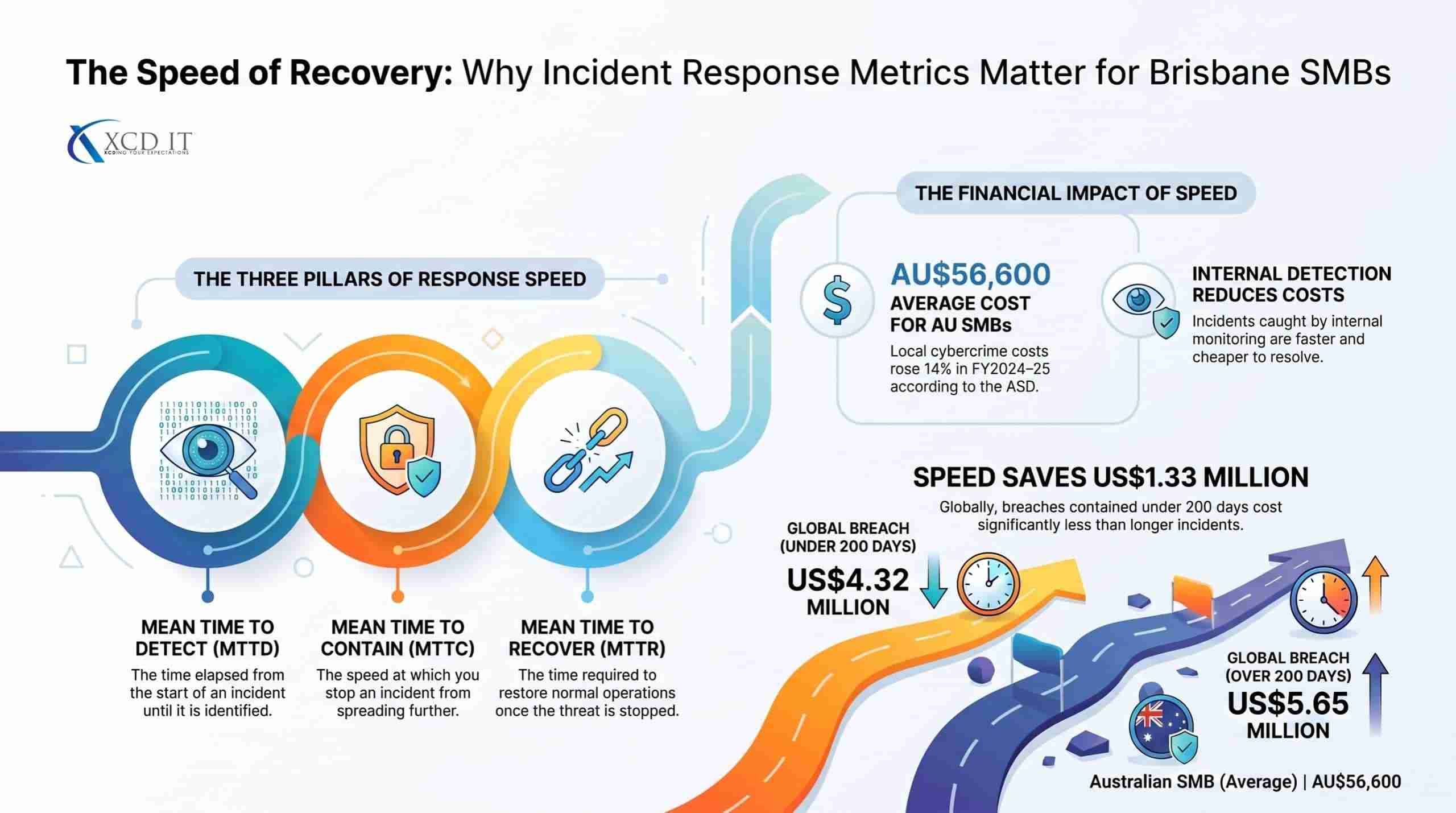
- The three core incident response metrics are mean time to detect, mean time to contain, and mean time to recover. Together they determine how much damage an incident does before it is stopped.
- Speed has a direct, measurable relationship with cost. Globally, breaches contained in under 200 days cost organisations an average of US$4.32 million, compared to US$5.65 million for breaches that ran longer, according to IBM’s 2026 Cost of a Data Breach Report.
- Australian small businesses paid an average of AU$56,600 per cybercrime report in FY2024–25, a 14% increase on the year before, according to the Australian Signals Directorate.
- Enterprise benchmarks are not a realistic target for most SMBs. What matters more is having any consistent way to measure and improve, rather than matching a large organisation’s resourcing.
- A Brisbane SMB without an in-house security team can still track these metrics using existing tools like MFA logs, endpoint alerts, and a simple incident log, rather than needing dedicated security software from day one.
Quick Answer
Incident response metrics for Brisbane SMBs are the measurements that show how well a business detects, contains, and recovers from a cybersecurity incident.
The core metrics are mean time to detect (MTTD), mean time to contain (MTTC), mean time to recover (MTTR), cost per incident, whether the incident was caught internally or by an outside party, and how often the same type of incident recurs.
Tracking these consistently, even with basic tools, gives a Brisbane SMB a clear picture of whether its cybersecurity setup is actually working, rather than assuming it is because nothing has gone wrong yet.
What Are Incident Response Metrics?
Incident response metrics are simply the measurements a business uses to understand how well it handles a cybersecurity incident from the moment something goes wrong to the moment normal operations are restored. They are not about preventing every incident.
No business, regardless of size or budget, can guarantee that. They are about understanding how fast a business notices a problem, how fast it stops the problem from spreading, and how fast it gets back to normal.
For a Brisbane SMB, these numbers matter for a simple reason. Speed is one of the few variables a business can actually control once an incident is already underway, and speed has a direct relationship with cost, downtime, and reputational damage.
Core Incident Response Metrics for Brisbane SMBs
Mean Time to Detect (MTTD)
This is how long it takes a business to notice that something is wrong, from the moment an incident actually begins to the moment it is identified. A slow MTTD means an attacker has more time inside a system before anyone even knows there is a problem, which is exactly the window where the most damage tends to happen.
Mean Time to Contain (MTTC)
Once an incident is detected, this measures how long it takes to stop it from spreading further. Containment might mean isolating an infected device, disabling a compromised account, or cutting off external access. A fast MTTC limits how much of the business is affected by a single incident.
Mean Time to Recover (MTTR)
This tracks how long it takes to restore normal operations once the incident has been contained. For many SMBs, this is the metric that connects most directly to the real cost of an incident, since every hour of disrupted operations has a measurable business impact. Our guide on IT downtime cost for Brisbane businesses breaks down what that impact actually looks like in dollar terms.
Cost per Incident
Tracking the actual cost of each incident, including lost productivity, remediation work, and any direct financial loss, gives a business a realistic baseline to measure improvement against over time.
Detection Source: Internal vs External
This tracks whether an incident was caught by the business’s own monitoring, or whether it was only discovered because a customer complained, a bank flagged unusual activity, or the attacker themselves made contact. Incidents caught internally are consistently faster to contain and cheaper to resolve than those discovered externally.
Recurrence Rate
This measures whether the same type of incident, such as a phishing compromise or a misconfigured account, keeps happening. A high recurrence rate is usually a sign that the underlying cause was never actually fixed, only the immediate symptom.
What the Data Says About Speed and Cost
Enterprise Benchmarks from Global Research
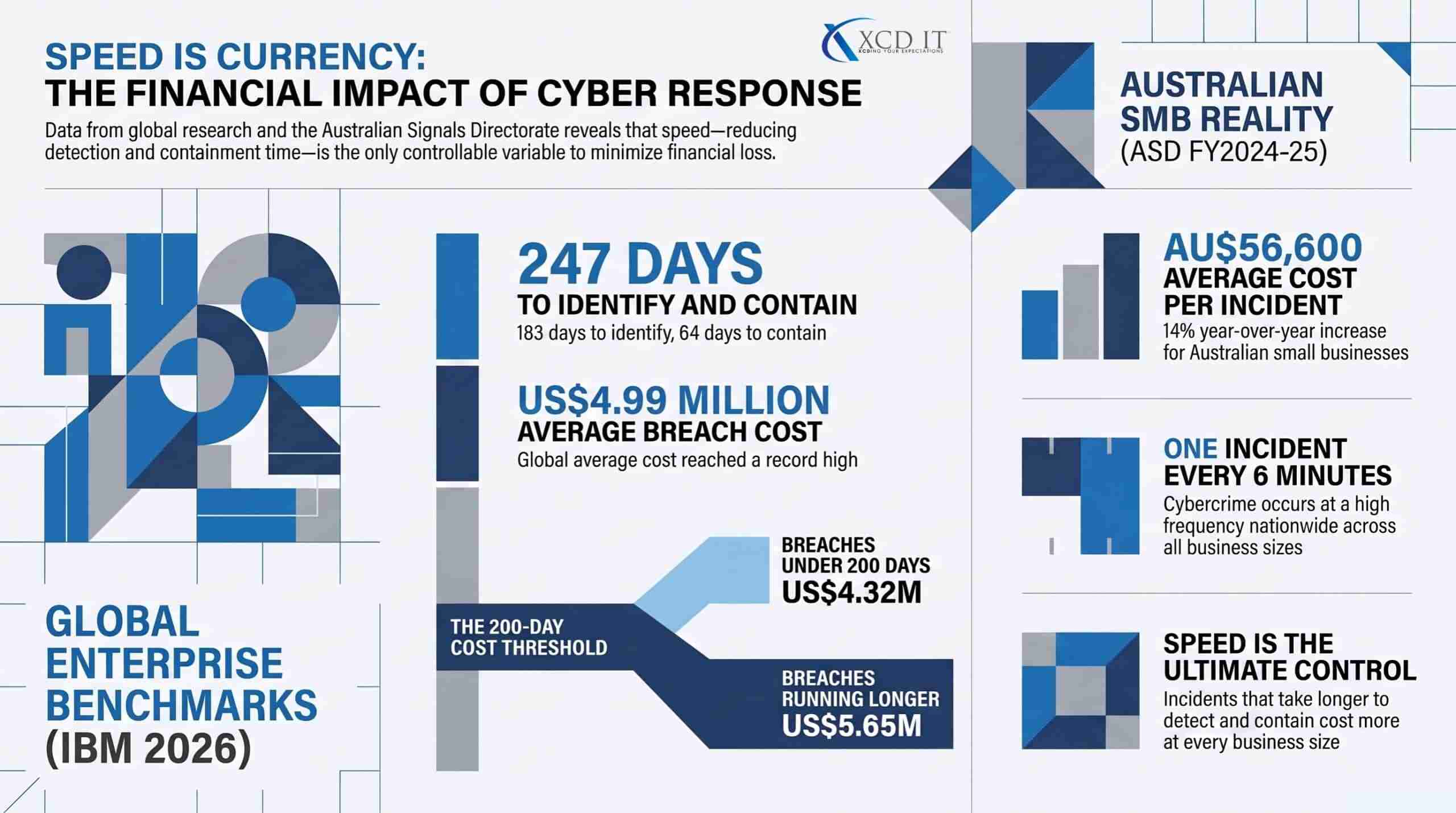
The clearest evidence for why these metrics matter comes from large-scale research into actual breach outcomes. According to IBM’s 2026 Cost of a Data Breach Report, the global average cost of a data breach reached a record US$4.99 million in 2026. The average time to identify and contain a breach was 247 days, made up of roughly 183 days to identify and 64 days to contain.
The cost difference tied to speed is significant. Breaches contained within 200 days cost an average of US$4.32 million, while those that ran longer averaged US$5.65 million. That gap exists almost entirely because of how long the incident was allowed to continue before it was properly contained.
Australian Small Business Numbers
The IBM figures above are drawn largely from larger organisations, so they are not a direct read on what a Brisbane SMB should expect. For a more locally relevant number, the Australian Signals Directorate’s Annual Cyber Threat Report 2024–25 found that Australian small businesses paid an average of AU$56,600 per self-reported cybercrime incident, a 14% increase on the previous year. The ASD also reported a cybercrime incident every 6 minutes across the country in FY2024–25.
Neither of these figures should be read as a specific prediction for any one business, but together they confirm the same underlying pattern: incidents that take longer to detect and contain cost more, at every business size.
Why Brisbane SMBs Shouldn’t Copy Enterprise Benchmarks Directly
It’s tempting to look at large-scale MTTD and MTTC benchmarks and treat them as a target. That’s usually the wrong way to use this data. Enterprise organisations measuring these metrics typically have dedicated security operations teams, purpose-built monitoring tooling, and budgets that most SMBs simply do not have access to.
What actually matters for a Brisbane SMB is having a consistent way to measure these metrics at all, and a clear trend showing whether they are improving over time. A small business that reduces its own detection time from, say, several days to a few hours has made meaningful progress, even if that number is nowhere near what a large enterprise reports.
How to Start Tracking These Metrics Without a Dedicated Security Team
Most Brisbane SMBs don’t have an in-house security operations centre, and they don’t need one to start tracking incident response metrics properly.
A simple incident log is the starting point. Every time something happens, a suspicious login, a phishing email that got clicked, a locked-out account, it gets logged with a timestamp for when it was noticed and when it was resolved. Over a few months, this alone starts to show patterns.
Existing tools usually already generate useful data. Multi-factor authentication logs show failed and suspicious login attempts. Email security tools flag and timestamp blocked phishing attempts. Endpoint protection software logs detection and response times automatically in most modern platforms.
The habit of reviewing this data regularly, even monthly, matters more than the sophistication of the tooling used to collect it. Many of the common IT support mistakes Brisbane businesses make come down to exactly this: having some security tools in place but never actually reviewing what they’re reporting.
What Slows Detection and Response Down for Brisbane SMBs
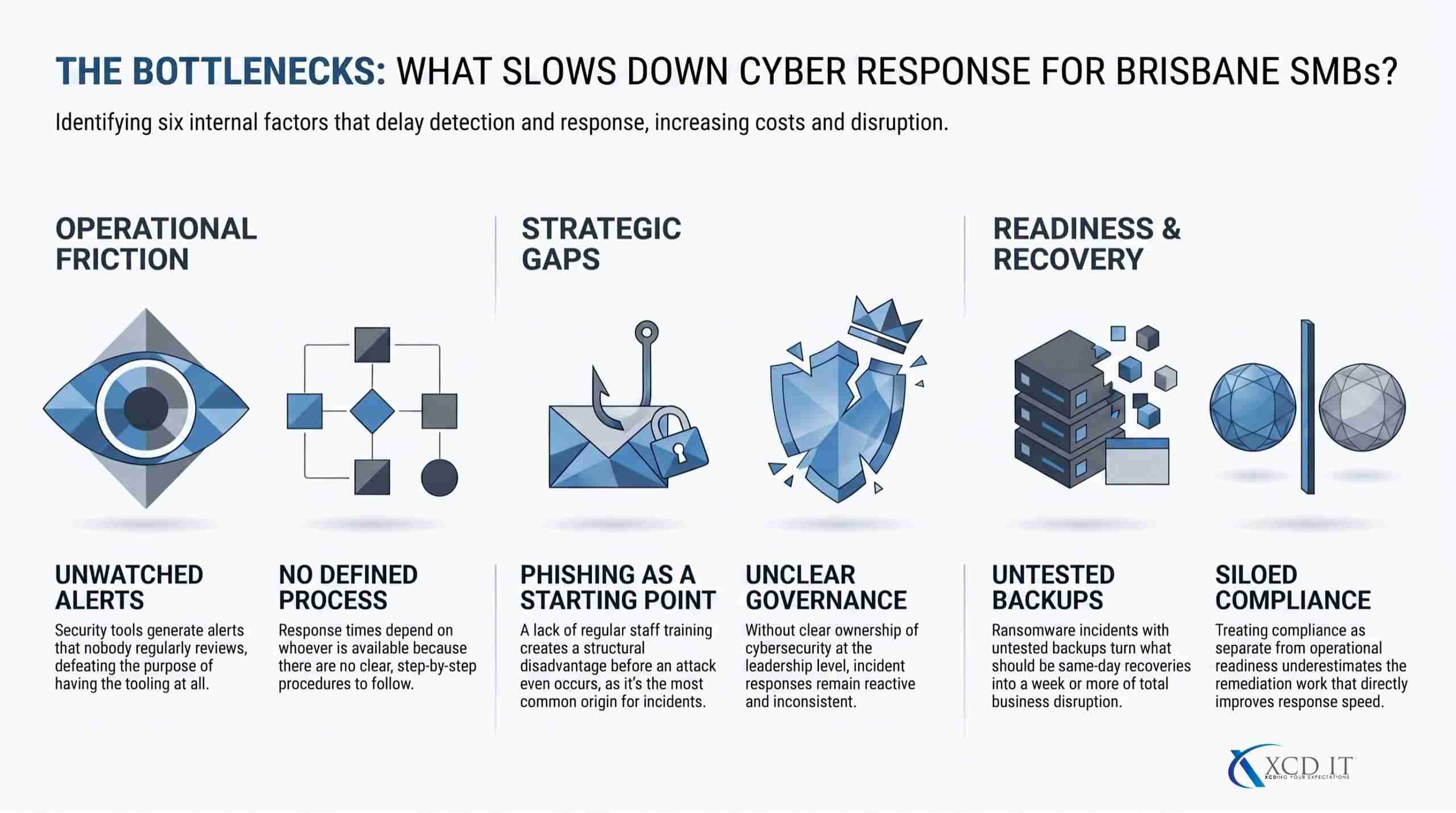
A few recurring issues show up again and again in why SMB incident response metrics stay slow.
No one is actually watching the alerts. Many SMBs have security tools that generate alerts nobody regularly reviews, which defeats the purpose of having the tooling at all.
There’s no defined process for what happens next. When an alert does get noticed, if there’s no clear step-by-step process for what to do, response time depends entirely on whoever happens to be available that day.
Phishing remains the most common starting point. Since phishing attacks on SMBs are still the most common way incidents begin, a business without regular staff training is starting from a structural disadvantage before an incident even occurs.
Governance is unclear. Without clear ownership of cybersecurity at a leadership level, incident response tends to be reactive and inconsistent rather than planned. Our guide on cybersecurity governance for SMBs covers what proper oversight actually looks like at the director level.
Backups aren’t tested. A ransomware incident with an untested backup can turn what should be a same-day recovery into a week or more of disruption, which directly inflates mean time to recover.
Compliance work gets treated as separate from operational readiness, when the two are closely linked. Our breakdown of the hidden costs of cybersecurity compliance covers how remediation work, the kind that directly improves these metrics, is often the most underestimated cost in the entire compliance picture.
How XCD IT Approaches Incident Response Metrics
XCD IT builds monitoring, detection, and response into its managed cybersecurity services for Brisbane, Gold Coast, and Sunshine Coast SMBs, rather than treating incident response as a separate, reactive project handled only after something has already gone wrong.
That means continuous monitoring designed to catch incidents internally rather than waiting for a customer or a bank to flag unusual activity, a documented response process so containment doesn’t depend on who happens to be available, and regular reporting so a business can actually see whether its detection and response times are improving over time.
This is delivered as part of XCD IT’s broader managed IT and cybersecurity plans, commonly priced in the AU$100 to $250 per user per month range, so a Brisbane SMB gets ongoing monitoring and response capability without needing to build and staff a security function internally.
Frequently Asked Questions

- 8+ Best Cybersecurity Companies in Brisbane (2026 Guide for SMBs) - November 7, 2026
- 20 Best Managed IT Service Companies in Brisbane (2026 Guide for SMBs) - November 7, 2026
- Co-Managed IT: How It Works With Your In-House IT Team - November 4, 2026


