
What does cybersecurity for legal compliance actually require, and why are so many organisations still getting caught out by it?
In short, cybersecurity for legal compliance means implementing and documenting the specific technical, administrative, and governance controls that regulators demand under frameworks like the Privacy Act 1988, the Cyber Security Act 2024, APRA CPS 234, and PCI DSS, and being able to prove it on demand.
This guide breaks down which frameworks apply to which organisations, what regulators actually want to see as evidence, how compliance differs from general cybersecurity, and the practical steps that keep a business audit-ready all year round rather than scrambling before a deadline.
Key Takeaways: Cybersecurity for Legal Compliance
- Cybersecurity for legal compliance means proving, with documented evidence, that your organisation meets externally imposed standards, not just having good security habits.
- Civil penalties under the Privacy Act 1988 can now reach up to $50 million (or a percentage of turnover) for serious or repeated breaches, showing Australian regulators are willing to impose serious financial penalties.
- The Cyber Security Act 2024 and directors’ duties under the Corporations Act 2001 now create personal liability for senior executives who fail to govern cybersecurity adequately, making this a board-level issue, not just an IT one.
- Regulators increasingly require tested recovery capabilities, not just written disaster recovery plans, under frameworks like APRA CPS 234 and the Cyber Security Act 2024.
- Audit logs, training records, and incident response documentation must exist and be producible on demand. A well-secured business that can’t produce evidence will still fail an audit.
- Mapping controls to a unified framework like the ASD Essential Eight Maturity Model reduces duplicated effort across overlapping obligations such as the Privacy Act 1988, APRA CPS 234, and PCI DSS.
- Treating compliance as a continuous operational discipline, rather than a once-a-year documentation exercise, is what separates businesses that pass audits from those that don’t.
Why Cybersecurity Compliance Catches Businesses Out
Most organisations don’t fail compliance because they’re careless about security. They fail because they treat compliance as a paperwork exercise rather than an operational one. Policies get written, boxes get ticked, and everyone assumes that’s enough. Then a regulator asks for evidence of a tested incident response plan, and there’s nothing to show.
The shift represented by frameworks like the Cyber Security Act 2024 and APRA CPS 234 is significant. These obligations don’t ask whether you have a disaster recovery plan. They ask when you last tested it, and what the results were. That’s a fundamentally different bar, and it’s one a lot of businesses aren’t clearing.

The Real Gap of Cybersecurity for Legal Compliance: Documentation vs Evidence
Compliance and general cybersecurity share many of the same controls, but they serve different purposes. General cybersecurity is about reducing risk based on your own risk appetite.
Compliance is about proving, to an external authority, that you’ve met a defined standard, with documented evidence such as audit logs, configuration records, incident response documentation, and staff training records.
You might reasonably decide not to encrypt a low-risk internal database as part of a general security posture. The Privacy Act 1988 removes that discretion entirely for personal information. That’s the difference: compliance isn’t optional, and it isn’t self-assessed.
Which Legal and Regulatory Frameworks Apply to You?
Cybersecurity legal requirements vary by sector, jurisdiction, and the type of data an organisation handles. Understanding which frameworks apply is the first step toward a defensible compliance position.
Privacy Act 1988
The Privacy Act 1988 applies to most Australian businesses with turnover over $3 million, plus certain smaller businesses handling sensitive data (health providers, credit reporting, etc). Recent reforms increased maximum civil penalties to $50 million or more for serious or repeated interferences with privacy, a clear signal that the OAIC will pursue significant penalties for non-compliance.
Cyber Security Act 2024
The Cyber Security Act 2024 introduced mandatory ransomware payment reporting, a Cyber Incident Review Board, and strengthened obligations for critical infrastructure providers under the existing SOCI Act, alongside director accountability for cybersecurity governance. For a closer look at what this means for boards, see our guide to cybersecurity governance for SMBs.
APRA CPS 234
APRA’s Prudential Standard CPS 234 targets APRA-regulated financial entities and their third-party service providers, requiring tested incident response plans, timely notification of security incidents, and ongoing third-party risk assessment. Financial services businesses navigating this alongside other obligations may find our cybersecurity strategy for financial services a useful companion piece.
Notifiable Data Breaches (NDB) Scheme
The Notifiable Data Breaches scheme, part of the Privacy Act 1988, requires organisations to notify the OAIC and affected individuals when a data breach is likely to result in serious harm. Failure to notify is itself a separate compliance breach, on top of any penalty for the original incident.
My Health Records Act & Health Privacy Obligations
The My Health Records Act 2012, alongside the Privacy Act’s health-specific provisions and relevant state health records legislation, mandates security and privacy controls for health information handled by Australian healthcare providers.
Payment Card Industry Data Security Standard

PCI DSS (Payment Card Industry Data Security Standard) applies to any organisation processing card payments, with specific requirements for encryption, access control, and monitoring.
Many organisations sit under more than one framework at once. A financial services firm, including financial advisers, may face both APRA CPS 234 and PCI DSS simultaneously. A healthcare provider may need to satisfy both state health records legislation and the Privacy Act at the same time.
Breach notification timelines also differ by framework. The Notifiable Data Breaches scheme requires notification to the OAIC and affected individuals “as soon as practicable” once an organisation becomes aware of an eligible data breach, while APRA CPS 234 sets its own separate timelines for regulated financial entities. Missing these deadlines is a compliance failure in its own right, entirely separate from the underlying security incident.
The Controls and Evidence Regulators Actually Want to See
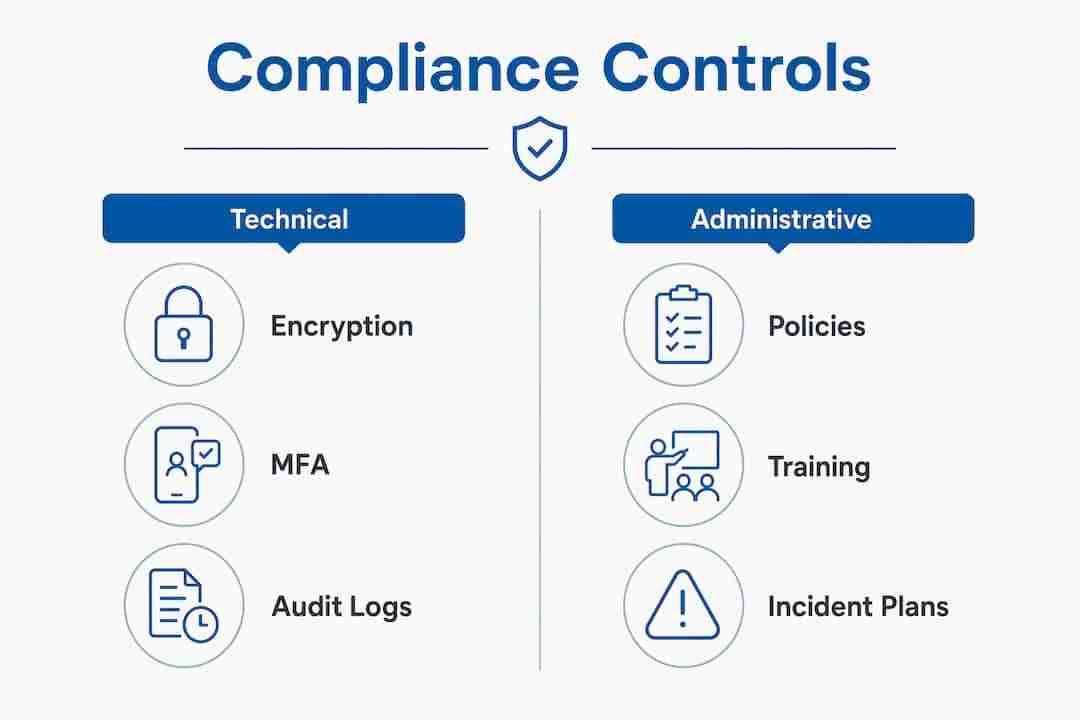
Compliance obligations break down into three categories: technical, administrative, and governance controls.
| Control category | Examples | Compliance purpose |
|---|---|---|
| Technical | Encryption, MFA, audit logging, immutable backups | Protect data and produce verifiable evidence |
| Administrative | Policies, training records, incident response plans | Document obligations and staff awareness |
| Governance | Board oversight, risk registers, internal audits | Assign accountability and demonstrate due diligence |
Technical controls are now the baseline. Immutable, tamper-resistant backups are increasingly expected under APRA CPS 234 and the Cyber Security Act 2024, because regulators need assurance that evidence hasn’t been altered after the fact. Encryption of data at rest and in transit is required under PCI DSS and expected as good practice under the Privacy Act 1988’s security obligations (APP 11).
Multi-factor authentication is close to universal across major frameworks, and endpoint detection and response tools provide the real-time visibility that audit logging requirements demand.
Administrative controls are the documentary backbone of a compliance program. Regulators expect written policies that reflect actual practice, not aspirational statements (our guide on how to create a cybersecurity policy walks through this step by step).
Training records prove staff understand their obligations, and incident response plans need to be tested, not just filed away. If you’re unsure what to do when a plan gets tested for real, see our guide on what to do after a cyberattack.
Governance controls tie it together. The ASD Essential Eight Maturity Model is widely used by Australian businesses to unify compliance across overlapping obligations like the Privacy Act 1988, APRA CPS 234, and PCI DSS, reducing duplicated audit work. Board oversight, documented risk management, and regular internal audits round out the governance picture.
Pro Tip: Build a compliance evidence register that maps each regulatory requirement to the specific document, log, or record that satisfies it. This single register can cut audit preparation time significantly and gives legal and compliance teams a clear, shared view of any gaps.
What Non-Compliance Actually Costs
The financial and legal exposure here is bigger than many organisations expect. Civil penalties under the Privacy Act 1988 now reach up to $50 million for serious or repeated breaches, or three times the value of any benefit obtained, whichever is greater.
Beyond the fines, the Cyber Security Act 2024 and directors’ duties under the Corporations Act 2001 now create personal liability for senior executives who fail to govern cybersecurity adequately, meaning a compliance failure can follow individual directors, not just the organisation’s balance sheet.
Operational resilience has also become a compliance issue in its own right. APRA CPS 234 and the Cyber Security Act 2024 require organisations to prove systems can be restored quickly after disruption, shifting the compliance mindset from paperwork to demonstrated capability.
How to Keep Cybersecurity Compliance On Track

- Automate monitoring and audit trails. Real-time monitoring generates the continuous evidence stream regulators expect; manual log reviews don’t scale.
- Test disaster recovery and business continuity plans, not just write them. APRA-regulated entities and critical infrastructure providers increasingly need automated failover testing and documented forensic recovery points.
- Review policies at least annually, or whenever a significant regulatory update occurs. Regulations change, and policies need to keep pace.
- Brief the board regularly. Directors who understand their personal liability under the Cyber Security Act 2024 and the Corporations Act 2001 make better governance decisions, and regular legal and IT briefings are effectively mandatory under these obligations, not optional extras.
- Unify your compliance program. Managing the Privacy Act 1988, APRA CPS 234, and PCI DSS as one connected control architecture, rather than three separate checklists, reduces duplication and closes gaps that fragmented ownership tends to create.
Pro Tip: Run a cybersecurity posture assessment at least once a year. It gives the board documented evidence of your compliance position and surfaces gaps before a regulator does.
Understanding cybersecurity law as a living body of regulation, rather than a fixed checklist, is the mindset that separates organisations that pass audits from those that scramble before them.
How XCD IT Supports Your Cybersecurity for Legal Compliance
Legal and compliance professionals need IT infrastructure that actively supports regulatory obligations, not infrastructure that creates new risk. XCD IT delivers managed IT services aligned with the ASD’s Essential Eight and major compliance frameworks, including continuous monitoring, immutable backup solutions, and audit-ready logging.
As a Microsoft Partner holding the SMB1001 Gold Cybersecurity Certification, XCD IT brings documented expertise to the compliance challenges facing Australian businesses, whether that’s satisfying Privacy Act 1988 obligations, meeting the requirements of the Cyber Security Act 2024, or preparing for a regulatory audit.
Contact XCD IT to discuss how managed IT services can reduce your compliance burden and strengthen your operational resilience.

Need Reliable IT Without the Surprise Costs?
With XCD IT, you get fully managed IT support for around $100–$250/month per user, with no hidden costs or unexpected bills.
Call 07 3085 7447
For urgent IT issues or immediate assistance
Our support team is ready to help.
Frequently Asked Questions: Cybersecurity for Legal Compliance

- 8+ Best Cybersecurity Companies in Brisbane (2026 Guide for SMBs) - November 7, 2026
- 20 Best Managed IT Service Companies in Brisbane (2026 Guide for SMBs) - November 7, 2026
- Co-Managed IT: How It Works With Your In-House IT Team - November 4, 2026


