
What is the difference between public vs private cloud, and which one is actually right for your business?
Most businesses start comparing the two and quickly get lost in vendor comparisons, pricing models, and technical jargon before anyone has answered the more basic question of what each one actually is and why the distinction matters. This guide cuts through that. It explains what public and private cloud mean in plain terms, where each one makes sense, and what most Australian businesses should actually be thinking about when making this decision.
Key Takeaways of Public vs Private Cloud
- Public cloud means your data and applications run on shared infrastructure managed by a provider like Microsoft, Google, or AWS. You don’t own or manage the hardware.
- Private cloud means the infrastructure is dedicated to your organisation, either hosted on your own premises or by a third party exclusively for you.
- Most Australian SMBs are already using public cloud whether they realise it or not. Microsoft 365, Google Workspace, and Xero are all public cloud services.
- For Australian SMBs, public cloud providers like Microsoft and Google offer enterprise grade security that most businesses cannot replicate with private infrastructure.
- The right answer for most businesses is neither pure public nor pure private, but a hybrid approach that puts the right workloads in the right environment.
What Is Public Cloud?
Public cloud is infrastructure (servers, storage, networking) owned and operated by a third-party provider and shared across thousands of customers. When you use Microsoft 365, Google Drive, Dropbox, or AWS, you are using public cloud. Your data sits on Microsoft’s or Google’s servers alongside data from millions of other organisations, logically separated but physically sharing the same hardware.
The defining characteristics of public cloud are that you don’t manage the underlying infrastructure, you pay for what you use, and the provider is responsible for the hardware, physical security, and the availability of the platform itself.
For most day-to-day business applications like email, file storage, video conferencing, and accounting software, public cloud is the default and makes complete sense. The major providers invest billions in their infrastructure and security in ways no individual business could replicate.
What Is Private Cloud?

Private cloud is infrastructure dedicated exclusively to one organisation. That infrastructure can be located on-premises (physical servers in your own office or data centre) or hosted by a third party but partitioned so that you’re the only tenant on that hardware.
The key distinction is exclusivity. In a private cloud environment, you’re not sharing underlying hardware with anyone else. You have full control over the configuration, security policies, and data residency of your environment.
Private cloud requires significantly more investment in hardware, IT expertise, and ongoing maintenance. In return, it offers greater control, customisation, and in some contexts, stronger compliance positioning.
A common misconception is that on-premises infrastructure and private cloud are the same thing. They’re not. A traditional on-premises server is just a server. Private cloud refers specifically to infrastructure that delivers cloud-like capabilities such as on-demand resource allocation, virtualisation, and self-service provisioning, but on dedicated hardware.
What Is Hybrid Cloud?
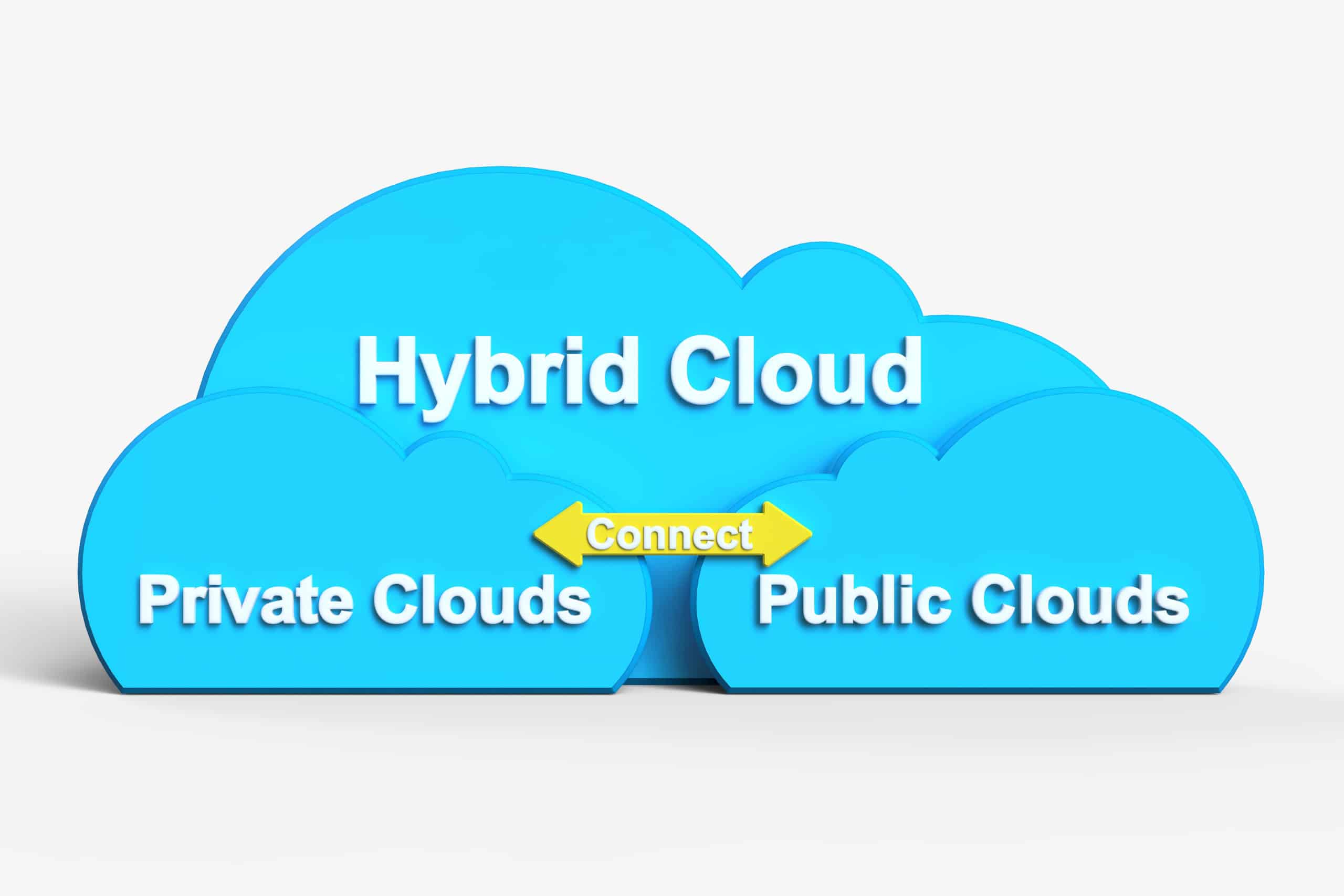
Hybrid cloud combines public and private cloud environments, allowing data and applications to move between them based on requirements. In practice, this is what most Brisbane businesses with any complexity in their IT environment are already running. Microsoft 365 in public cloud for email and collaboration, an on-premises server for a legacy application or local file storage, and perhaps a cloud-hosted backup solution.
The hybrid model exists because few businesses have workloads that fit neatly into one category. Sensitive client data might sit in a private environment while staff productivity tools run in public cloud. A business might run day-to-day operations in public cloud but maintain a private environment for regulatory reasons around specific data types.
Is Microsoft 365 Public Cloud and What It Means for Your Business
Microsoft 365 is public cloud. It runs on Microsoft’s shared global infrastructure, the same data centres used by millions of other organisations, with your data logically separated but not held on hardware dedicated to you alone.
For most Brisbane SMBs, this is exactly why Microsoft 365 makes sense. Microsoft invests far more in security, redundancy, and compliance certification across that shared infrastructure than an individual business could ever justify for itself. The trade-off is that you are operating within Microsoft’s platform boundaries rather than a fully custom environment, which is rarely a real constraint for standard business use.
If your business has a specific reason to need infrastructure that is not shared, such as strict data isolation requirements in a regulated industry, that is a private cloud conversation. For the vast majority of Brisbane SMBs using Microsoft 365 for email, file storage, and collaboration, public cloud is not just acceptable, it is the right architecture.
Public vs Private Cloud: The Key Differences
| Public Cloud | Private Cloud | |
|---|---|---|
| Cost | Pay-as-you-go, no hardware investment | High upfront hardware and ongoing maintenance costs |
| Security | Enterprise-grade security managed by the provider | Only as secure as your internal team can manage |
| Control | Control within the provider’s boundaries | Full control over configuration and architecture |
| Scalability | Scale up or down in minutes | Limited by how fast you can procure hardware |
| Reliability | 99.9%+ uptime SLAs with redundant data centres | Dependent on your own hardware and setup |
| Compliance | Australian data residency available (e.g. Microsoft Azure) | Easier to meet highly specific regulatory requirements |
| Best for | Most SMBs, cloud-first environments | Regulated industries, legacy systems, high-volume workloads |
Cost of Public vs Private Cloud
Public cloud operates on a consumption model. You pay for what you use with no capital expenditure on hardware, which makes it accessible and easy to scale. Private cloud requires upfront investment in physical hardware, plus ongoing costs for maintenance, power, cooling, and the IT staff to manage it.
For most Brisbane SMBs, public cloud is significantly more cost-effective, particularly when you factor in what it would cost to match the reliability and security of a major provider on your own infrastructure.
Security of Public vs Private Cloud

This is where the most common misconception lives. Private cloud is not inherently more secure than public cloud. The major providers (Microsoft, Google, AWS) operate security programmes vastly more sophisticated than what any individual business could implement on its own. They employ dedicated security teams, run continuous threat monitoring, and maintain certifications like ISO 27001 and SOC 2 that most private cloud environments cannot match.
Where private cloud can offer a security advantage is in specific scenarios where the attack surface needs to be tightly controlled, where air-gapping from the internet is required, or where the business has strong in-house IT expertise to manage the environment properly. For most SMBs, that last condition alone rules it out.
Control of Public vs Private Cloud
Private cloud gives you full control over configuration, patching schedules, network architecture, and where data physically resides. Public cloud gives you control within the bounds the provider allows, which is sufficient for most use cases but can be a constraint for organisations with specific technical or compliance requirements. For businesses that need to customise their environment at a deep level, private cloud is the more flexible option.
Scalability of Public vs Private Cloud
Public cloud scales almost instantly. Need more storage or compute capacity? You provision it in minutes. Private cloud scales only as fast as you can procure and install new hardware, which typically takes weeks or months. For businesses with variable or growing workloads, public cloud’s scalability is a significant operational advantage.
Reliability of Public vs Private Cloud

Major public cloud providers publish uptime SLAs of 99.9% or higher and maintain redundant infrastructure across multiple data centres. If one data centre goes down, traffic automatically shifts to another. Matching that level of reliability with on-premises private cloud infrastructure is expensive and technically demanding. Most SMBs running their own servers are more vulnerable to downtime from hardware failure, power issues, or local disasters than they would be running equivalent workloads in public cloud.
Compliance and Data Residency
Australian businesses handling personal information, health data, or industry-regulated data sometimes face requirements about where data is stored and who can access it. Public cloud providers have addressed most of these concerns. Microsoft Azure, for example, has Australian data centre regions and offers data residency guarantees that satisfy the requirements of most businesses under the Privacy Act. In some highly regulated environments, private cloud or hybrid arrangements remain the cleaner compliance answer, but these cases are less common than many businesses assume.
When Private Cloud Actually Makes Sense
Private cloud is the right answer in specific circumstances, and it’s worth being clear about what those are rather than dismissing it entirely.
Organisations with highly sensitive data and strict regulatory requirements (certain government agencies, defence contractors, some healthcare providers) may need an environment that is physically isolated from shared infrastructure and subject to specific audit and access controls that public cloud cannot accommodate.
Businesses with very predictable, high-volume workloads sometimes find that owning infrastructure is more cost-effective at scale than paying public cloud consumption rates. This calculation typically only works above a certain size and for most Brisbane SMBs, it doesn’t apply.
Businesses that rely on legacy applications that cannot be moved to cloud environments may need to maintain on-premises infrastructure indefinitely for those specific workloads while running everything else in public cloud.
Public vs Private Cloud: What Most Brisbane SMBs Actually Need
For the majority of small and medium businesses in Brisbane, the honest answer is that public cloud, or a hybrid arrangement with a limited on-premises footprint, is the right fit.
If your business runs on Microsoft 365, uses cloud-based accounting software, and stores files in SharePoint or OneDrive, you are already in public cloud. The question isn’t usually whether to adopt public cloud. It’s whether the configuration of that environment is secure, well-managed, and appropriate for your compliance obligations.
The businesses that genuinely need private cloud infrastructure are a minority. What’s more common is businesses running ageing on-premises servers that haven’t been migrated to cloud yet, not because private cloud is the right answer, but because migration simply hasn’t happened. That’s a different problem, and the solution is usually a planned migration to public cloud, not an investment in private cloud infrastructure.

Need Reliable IT Without the Surprise Costs?
With XCD IT, you get fully managed IT support for around $100–$250/month per user, with no hidden costs or unexpected bills.
Call 07 3085 7447
For urgent IT issues or immediate assistance
Our support team is ready to help.
The Security Question for Australian Businesses
Under the Privacy Act 1988 and the Australian Privacy Principles, businesses holding personal information are required to take reasonable steps to protect it. The question of whether public or private cloud better satisfies that obligation depends on execution, not the model itself.
A poorly configured public cloud environment with weak access controls, no MFA, and no monitoring is far less secure than a well-configured one, regardless of whether the underlying infrastructure is shared. Similarly, a private cloud environment with inadequate patching and no security monitoring is not more secure simply because it sits on dedicated hardware.
What matters is how the environment is configured and managed, not which model it sits in.
Frequently Asked Questions About Public vs Private Cloud
The Bottom Line of Public vs Private Cloud
The public vs private cloud debate is less relevant for most businesses than the marketing around it suggests. Public cloud, deployed correctly with proper security configuration and access controls, is the right answer for the majority of Brisbane SMBs. Private cloud makes sense in specific, well-defined circumstances that apply to a minority of organisations.
What matters more than the model is how well your cloud environment is configured, monitored, and maintained, regardless of whether it’s public, private, or hybrid.
XCD IT helps Brisbane businesses make the right cloud decisions and implement them properly, from Microsoft 365 configuration to hybrid cloud architecture and security. Contact us here or call 07 3085 7447 to discuss your environment.

- 8+ Best Cybersecurity Companies in Brisbane (2026 Guide for SMBs) - November 7, 2026
- 20 Best Managed IT Service Companies in Brisbane (2026 Guide for SMBs) - November 7, 2026
- Co-Managed IT: How It Works With Your In-House IT Team - November 4, 2026


